
Services
Berkeley Disinfection and Sanitizing
Our commercial disinfecting services give the handles, fixtures, counters and shared equipment in Berkeley workplaces focused care, either on every scheduled visit or on a date you choose.
The surfaces hands reach all day
Every building has a short list of places that nearly everyone touches: the entry door pull, the elevator call button, the stair rail, the light switch by the conference room, the faucet lever and the handle on the break room refrigerator. Those points carry most of a day’s contact, so they anchor the disinfection plan for each building.
During the walkthrough we mark those points room by room and write them into the task list. A busy office ends up with a different list than a storefront or a classroom wing, because the traffic, the hardware and the equipment differ. Your list is kept on file, so every visit treats the same surfaces in the same order.
Residue comes off, then the disinfectant goes on
Disinfectant works on a clean surface, so each point is wiped free of dust, grease and fingerprints with a detergent before anything else is applied. Once that film is gone, the disinfectant goes on and stays wet for the full dwell period the manufacturer sets, and it is never rushed off with a dry cloth.
Sanitizing and disinfecting each have their place. Sanitizers suit surfaces that meet food, such as break room counters, table tops and refrigerator handles, while disinfectants go on restroom fixtures, door hardware and other high-contact points. Products are never combined, rooms stay ventilated while we work, and every surface gets the product its material calls for, so stainless, laminate and painted finishes keep their look. For food-contact surfaces shared between kitchen tenants, see shared kitchen cleaning in Berkeley.
Commercial disinfecting services, in plain terms
Cleaning, sanitizing and disinfecting are three separate steps, and the CDC and EPA use each word for a specific job. Cleaning removes dirt, grease and germs from a surface with soap or detergent. Sanitizing lowers the number of germs on a surface to a safer level. Disinfecting uses an EPA-registered product to kill the germs named on its label, and it does that job only when the surface stays wet for the contact time the label gives.
Our commercial disinfecting services follow that order at every point on your list: clean first, then sanitize food-contact surfaces or disinfect high-touch hardware, then leave the product in place for its full dwell time. Your task list shows which surfaces get which step, so your team knows exactly what each visit covered.
Restrooms, break rooms and front entries
Restrooms receive the most detailed pass: flush handles, stall latches, faucet levers, soap and towel dispenser controls, hand dryer buttons, baby changing stations and the inside of the exit door, where every visitor’s hand lands last. Fixtures are cleaned first, then disinfected, and the floor around them is finished afterward so the room is ready for morning. Grout, scale and drains are handled by restroom deep cleaning.
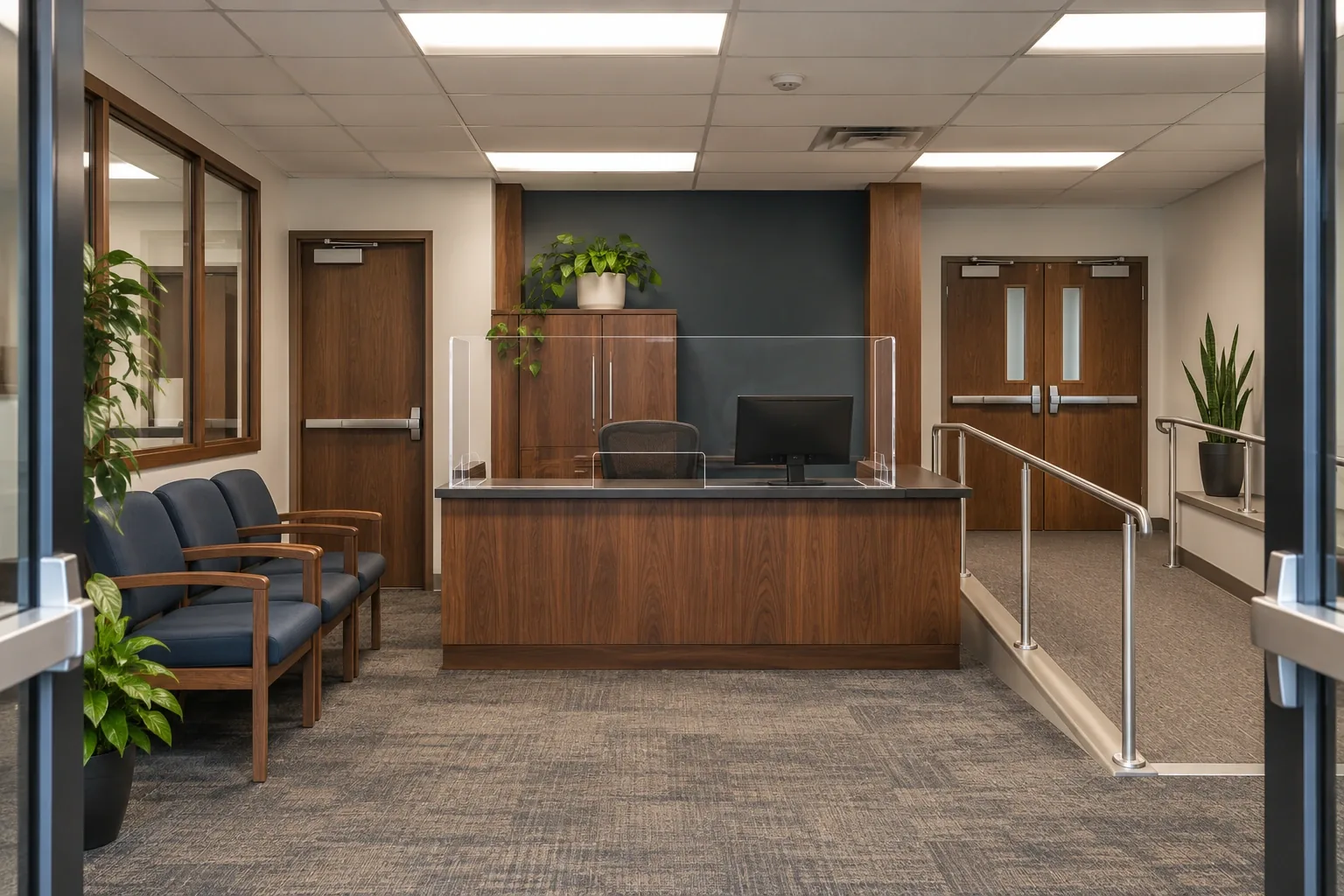
Break rooms get the microwave keypad, coffee machine buttons, water dispenser levers, cabinet pulls, sink basin and the tables where people eat. At the front entry, the push bar, accessible door button, reception counter edge, sign-in pen and visitor seating arms are treated before the lobby floor is cleaned, so the first thing a guest touches the next day is already clean.
Desks, devices and shared equipment
Shared workstations, conference tables, copier control panels, desk phones and the remotes for meeting room screens all collect steady contact, especially in offices where staff rotate between desks. These go on the disinfection list by room, and your list notes which items a team wants included and which personal desks stay untouched.
Electronics are handled with care: the product is applied to a cloth rather than sprayed toward a keyboard, touchscreen or card reader, and moisture never pools near ports or seams. Fitness studios, maker spaces and labs with shared tools follow the same approach for grips, handles and control knobs.
Part of nightly service or booked on its own date
Touchpoint disinfection can fold into your recurring janitorial visits, at a frequency that matches how busy the building is: every night for a crowded lobby, a few nights a week for a quiet suite. It runs through the same task list and the same visit, so there is no extra crew to schedule and no second set of keys to hand out.
On-request visits cover the moments that call for more: after a stretch of illness in the office, before a closed space reopens, ahead of a move-in, or following a weekend event. Daytime touchpoint rounds pair well with day porter service, so door hardware and restrooms get a second pass while the building is full. Visits fit your hours, including evenings and weekends.
Where it matters most in Berkeley
Each kind of property brings its own mix. Office floors that share blocks with theaters, galleries and event venues see heavy turnover in their lobbies and restrooms. Shops and cafes handle constant counter contact, card terminals and customer restrooms, which makes a short nightly touchpoint round worthwhile.
Medical suites want waiting room chair arms, check-in counters and shared restrooms disinfected after the last appointment, and exam or procedure rooms can be booked for terminal cleaning, a complete top-to-bottom clean and disinfection of a cleared room. Preschools, after-school programs and classrooms receive the same care for desks, cubby handles, sink fixtures and drinking fountain buttons, completed after the children go home.
What shapes the price
The touchpoint list drives the time. A suite with two restrooms and one break room needs far less than a building with restrooms on every floor, a public lobby and a dozen meeting rooms. Equipment density matters too, since a room full of shared devices takes longer than an open floor of personal desks.
Frequency, timing and how the work is booked set the rest. Disinfection added to an existing nightly visit costs less per pass than a standalone trip, and a single on-request visit is priced on the rooms and surfaces it covers. Terminal cleaning of exam rooms is quoted by the room. We walk the space with you, settle the list, and send a written quote.
Common questions
How do you decide which surfaces go on our disinfection list?
We walk the property with you and mark the hardware, fixtures and equipment that staff and visitors touch most in each room. That list is written into the task sheet, and you can add or remove items at any time.
Can touchpoint disinfection happen while our doors are open?
Yes. A daytime round covers door pulls, counters, card terminals and restrooms during business hours, working around customers and staff, and the full pass follows after closing.
How are keyboards, touchscreens and card readers treated?
The product goes onto a cloth first, never sprayed at the device, and the surface is wiped without letting moisture reach ports or seams. Any device you want left alone is noted on your list.
Can disinfection be scheduled right after a weekend event at our venue?
Yes. We book the visit for the night of the event or the following morning, so restrooms, door hardware, seating and counters are ready before the building opens again.
Is disinfection an add-on to our janitorial visits or a separate service?
Either works. It can join your recurring visits at a set frequency, or be booked as a single visit when the need comes up. Both run from the same written task list.
Is sanitizing the same thing as disinfecting?
Sanitizing lowers the number of germs on a surface and suits food-contact areas such as break room counters. Disinfecting uses an EPA-registered product, left wet for its label contact time, on restroom fixtures and high-touch hardware.