
Services
Commercial Restroom Deep Cleaning in Berkeley
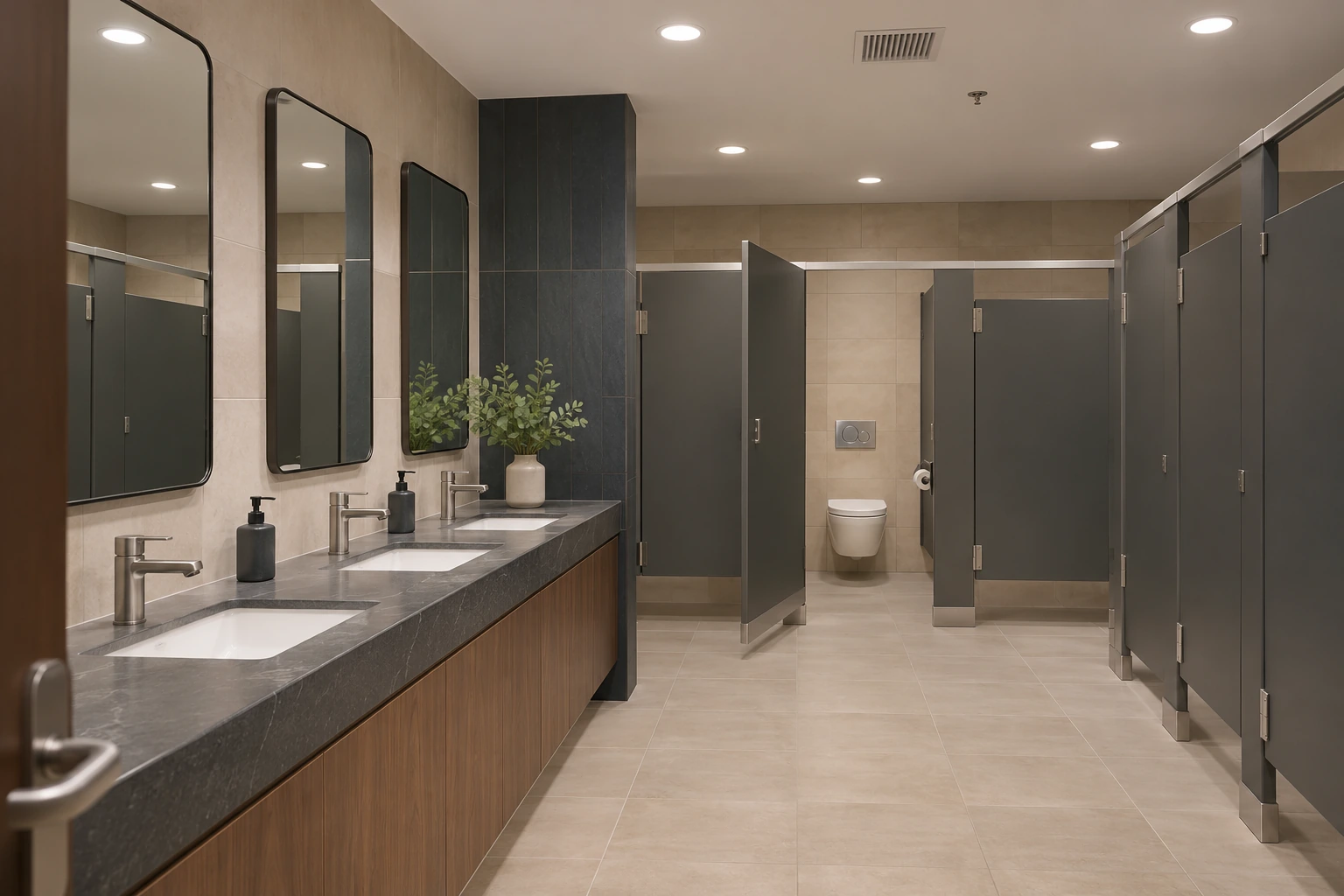
Periodic commercial restroom deep cleaning for Berkeley offices, shops, schools and light industrial buildings, restoring grout, fixtures and partitions on top of recurring janitorial care.
Restrooms that look tired even right after a cleaning
Each recurring Berkeley Janitorial visit sanitizes fixtures, empties bins, restocks paper and soap and mops the floor. A restroom can get that care every night and still start to look worn. The grout darkens a shade each month, a chalky ring creeps up the inside of the urinals, and partitions pick up a haze around the latches. That is build-up a nightly wipe and mop were never meant to remove.
Restroom deep cleaning is a separate, periodic service that resets those surfaces and then keeps them from sliding back. Take our commercial restroom cleaning checklist on your next floor walk and mark the fixtures, partitions and grout that need more attention.
Picture a two-story office building with a pair of restrooms on each floor. Nightly service keeps them tidy, yet by spring the floor tile has a dull cast and the urinal screens sit on a stained patch of grout. A first deep-clean visit takes care of that backlog, and a steady interval afterward stops it from returning.
What commercial restroom deep cleaning covers
- Tile floors scrubbed joint by joint with a rotary machine, with an extraction or auto-scrubber pickup so the dirty water leaves the room
- Toilet bowls, urinals and sink basins descaled, with extra time at the foot of each fixture and the wall behind it
- Floor drains brushed inside and run clear
- Stall partitions and doors washed from the upper edge down, with wall tile or wainscot getting the same care
- Air vents, light lenses and the tops of partitions dusted, then wiped
- Hand dryers, dispensers, faucets and flush valves detailed by hand
- High-touch points, from stall latches and door pulls to dispenser levers, cleaned and then disinfected
- Baseboards and floor corners scrubbed where a mop leaves a line
Restroom smells almost always start low: in the grout beside the urinals, in the trap of a floor drain, in the joint where a toilet meets the tile. Scrubbing those spots clean is what keeps the air fresh. Fragrance only hides the problem for a few hours.
Disinfecting what every hand touches
Once the soil is off, fixtures and touchpoints receive EPA-registered disinfectants. Each product stays on the surface for the dwell time its label lists before anyone wipes it, which is the step that lets a disinfectant do its work. Flush handles, faucet levers, stall latches, door pulls and dispenser buttons all get that treatment. The same method runs through our Berkeley disinfection and sanitizing service.
Setting the rhythm for each restroom
Traffic decides the interval. A staff restroom in a small maker space sees a fraction of the visits that a customer restroom in a busy shop does, and the plan reflects that difference.
Every week, for restrooms in near-constant use:
- Scale touch-ups on urinals, bowls and faucets
- Partition and stall door wipe-downs, inside and out
- A flush of every floor drain
- Corner and edge scrubbing along the walls
Every month, for typical offices and clinics:
- A machine scrub of the full floor, grout included
- Glazed wall tile washed down
- Ceiling vents and the tops of partitions dusted
Every quarter, as a full restoration:
- Heavy scale cleared from each fixture
- A deep scrub that brings grout back toward its original color
- Every partition panel and wall washed
- Light covers cleaned
Berkeley buildings where it earns its keep
Multi-story offices often share restrooms by floor, so one tired room affects every tenant on it. Shops and restaurants depend on a customer restroom that holds up to a weekend rush. On the industrial side, light industrial and warehouse buildings have staff restrooms that take boots, dust and shift changes.
Schools, medical offices, gyms and the office wings of life-science buildings round out the list. Each one gets intervals sized to its own traffic.
Multi-tenant buildings tend to benefit most. When several businesses share a corridor restroom, nobody owns the problem of a stained floor or a scaled urinal, so a scheduled deep clean keeps the shared rooms from drifting below the standard of the suites around them.
Restroom deep clean payoffs
- Air that stays fresh without a fragrance machine
- Fixtures and grout that last longer when scale is not left to etch them
- Fewer complaints from staff, tenants and customers
- Restrooms you would happily walk an inspector or a would-be tenant through
- A stronger first impression on every visitor who walks in
Working around your hours
Deep cleaning is booked for evenings, nights or weekends. If your building stays open late and has two or more restrooms, crews take them out of service in turn so people still have one to use; a lone restroom is saved for the hours after the last person leaves. The visit is planned around your recurring janitorial service so both sets of work fit the same off-hours window, and day porter restroom checks and restocking can carry the results through busy business days.
What sets the price
There is no flat rate. The quote follows the restrooms themselves:
- Restroom and fixture count
- How much scale and staining has built up before the first visit
- The interval you choose
- Floor and wall materials, such as ceramic tile, quarry tile or painted block
- When crews can get into the building
Checked against the same list
Supervisors run quality inspections against the task list written for each restroom: fixtures free of scale at the rim and base, partitions clean to the top edge, grout an even color across the floor, drains running clear with no odor, and every dispenser working and full. Because that list is written down, the inspection measures the room against exactly what the crew worked from, and each interval starts from a standard you can see.
Common questions
What does a restroom deep clean add to our recurring janitorial visits?
Recurring visits handle fixtures, bins, restocking and mopping. The deep clean goes further: grout scrubbed by machine, scale taken off fixtures, drains flushed, and partitions and walls washed.
Which interval suits a busy customer restroom?
Weekly detail work keeps a high-traffic customer restroom ahead of scale and odor, often paired with a quarterly restoration visit.
What makes a restroom smell when it looks clean?
Odor sources usually sit in grout, floor drains and the tile around urinals and toilets. Scrubbing and flushing those areas removes the cause.
What kind of disinfectant goes on the fixtures?
Crews use EPA-registered products and give each one the dwell time its label lists, always on a surface that has already been cleaned.
Can the work happen while our building is open?
Yes, where there is more than one restroom: crews take them out of service one at a time so another stays open. A single restroom is done after closing.
How often should a Berkeley restroom get a deep clean?
Set it by traffic. Restrooms in near-constant use get weekly detail work, typical offices and clinics a monthly machine scrub, and a quarterly visit brings any restroom back to a full reset.